74 Short-Term Loan Statistics and Lending Trends for 2026

Understanding how people borrow money in the UK can help put the wider credit market into context. While short-term loans are one option available to some borrowers, they're only one part of a much broader lending landscape that includes credit cards, overdrafts, Buy Now, Pay Later products, personal loans and other forms of consumer credit.
This guide brings together the latest publicly available statistics on short-term borrowing, lending trends, affordability and consumer behaviour – a list of sources is provided at the end of the article. Alongside the data, we've included explanations of how short-term loans work, how they're regulated, and what borrowers should consider before applying for any form of credit.
At Moneyboat, we believe financial information should be clear, balanced and easy to understand. Borrowing isn't the right solution for every situation, and short-term credit may not be suitable if you're already experiencing ongoing financial difficulties. This page is intended to help explain the market, not encourage borrowing.
You can find full details on costs, repayments, and eligibility for Moneyboat short-term loans on our website.
Warning: Late repayment can cause you serious money problems. For help, go to moneyhelper.org.uk
Key short-term loan statistics in the UK
These headline figures show how short-term borrowing is used across the UK today. They sit within a wider picture of consumer credit use, alongside products like credit cards, overdrafts, and personal loans, as well as ongoing financial pressure for some households.
- 3.5 million UK adults used high-cost credit in 2024, up from 2.8 million in 2022 → Read more
- 1.3 million adults held a short-term instalment loan in 2024 → Read more
- 7.4 million UK adults struggled to pay bills or credit repayments → Read more
- 10.9 million UK adults used Buy Now, Pay Later in 2024 → Read more
- Average interest rate on new personal loans to individuals was 9.01% in April 2024 → Read more
- 20% of people report having no savings → Read more
A lack of savings can make it more difficult to absorb unexpected costs. People manage these situations in different ways depending on their circumstances, including adjusting spending, seeking support, or reviewing available financial options.
Short-term borrowing may be one of several options depending on individual circumstances. If approved, funding times can vary depending on the lender and the borrower’s bank.
Andy Forsyth, Chief Financial Officer at Evergreen Finance London Ltd, parent company and FCA-authorised lender behind Moneyboat comments:
"Statistics can help explain how people borrow, but they rarely tell the whole story. Short-term credit serves different purposes for different households, and the figures should always be viewed alongside wider pressures such as housing costs, inflation and wage growth.
“Understanding those factors gives a more balanced picture of why people may look for short-term finance, while recognising that borrowing is not the right solution for every situation."
Understanding short-term loans
Before exploring the latest statistics, it's useful to understand how short-term loans fit within the wider UK credit market.
What is a short-term loan?
A short-term loan is designed to help cover temporary financial needs and is typically repaid over 6 months or less, often in instalments. People may use this type of borrowing to cover unexpected expenses or essential costs while waiting for income.
As with any credit product, borrowers should only take out a loan if they're confident they can afford the repayments. Regulated lenders must carry out affordability assessments before approving an application.
Short-term loans vs payday loans
Although the terms are sometimes used interchangeably, payday loans and short-term loans aren't always the same thing.
Traditionally, payday loans were intended to be repaid in full on a borrower's next payday, often within a month. Today's regulated short-term lending market includes a wider range of repayment options, with many lenders offering instalment-based repayment schedules over several months.
Moneyboat offers high-cost short-term loans with scheduled repayments. We do not offer traditional payday loans.
Today, all authorised short-term lenders must comply with FCA rules covering affordability, responsible lending, clear customer communications and the treatment of customers in financial difficulty.
How are short-term loans regulated?
Authorised short-term lenders operating in the UK are regulated by the Financial Conduct Authority (FCA), which sets rules designed to protect consumers.
These rules include affordability assessments, standards around treating customers fairly, and limits on the total cost of borrowing for high-cost short-term credit. This regulatory framework was introduced to improve consumer protections and create greater transparency across the market.
When might a short-term loan not be suitable?
Short-term borrowing isn't appropriate for every situation.
If you're already struggling with ongoing debt, regularly relying on borrowing to cover everyday expenses, or aren't confident you'll be able to repay a loan on time, taking on additional credit may not improve your financial situation.
In these circumstances, it's worth exploring other options first, such as speaking with existing creditors about payment arrangements or seeking free, independent debt advice.
Andy Forsyth, Chief Financial Officer at Evergreen Finance London Ltd, parent company and FCA-authorised lender behind Moneyboat comments:
“Unsecured credit works best as a short-term financial tool rather than a long-term solution. Before applying for any loan, it's worth asking yourself whether the expense can be delayed, reduced or managed in another way. Borrowing should only be considered if the repayments are affordable alongside your existing financial commitments, both now and over the coming months.
“There are also times when borrowing may not be the right choice. If you're already struggling to cover essential household bills, relying on credit to meet everyday living costs, or unsure how you'll repay a new loan, taking on additional borrowing could make your situation more difficult. In these circumstances, it's often better to seek free, independent debt advice and explore the support that's available before committing to any form of credit.
“Where borrowing is appropriate, choosing a regulated lender that carries out affordability checks and provides clear information about repayments can help ensure the credit is suitable for your circumstances.”
Short-term loan market size and usage trends in the UK
Short-term lending plays a specific role for people managing temporary financial gaps. The figures below show how widely these products are used, how much people typically borrow, and how the market works.
1. 3.5 million UK adults used high-cost credit in 2024 (up from 2.8 million in 2022)
This increase from 5.3% to 6.4% of adults suggests a gradual rise in the use of high-cost credit products. This may reflect changing financial circumstances for some households, particularly when short-term borrowing is used to bridge temporary gaps rather than ongoing financial needs.
2. 1.3 million adults held a short-term instalment loan in 2024
Instalment loans are used by fewer people than other forms of credit. These loans have fixed repayment schedules over an agreed term, which can make repayment amounts and dates clearer for borrowers.
Moneyboat provides short-term loans in the UK and also explains other types of loans, including instalment loans and payday loans.
Warning: Late repayment can cause you serious money problems. For help, go to moneyhelper.org.uk.
3. Typical short-term loan values are under £1,000
Lower borrowing amounts indicate that these loans are generally used for specific, short-term costs rather than large purchases.
The relatively small average loan size suggests these products are often used to cover immediate expenses, as supported by Moneyboat customer research and the capture of the loan purpose on applications. This may include situations where income and outgoings do not align, rather than planned or discretionary spending.
4. Loan applications rose from 3.7 million to 11.5 million between 2023 and 2025
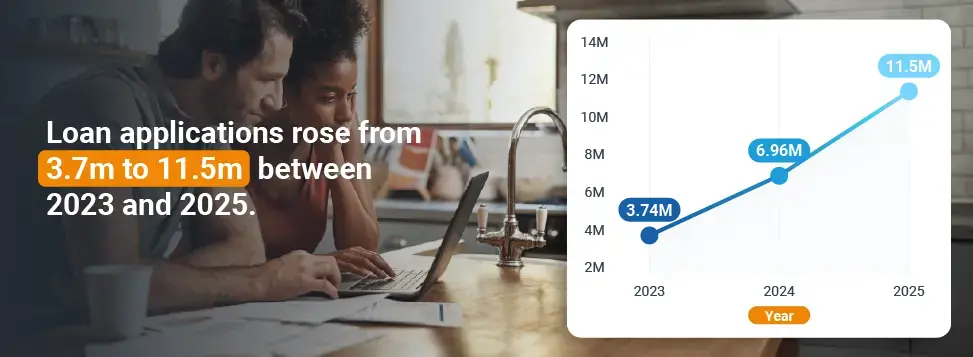
Moneyboat application data shows that applications have historically been higher in the run-up to Christmas. This coincides with a period when many households face higher seasonal spending and is included here as additional context alongside national borrowing trends.
Total applications increased by around 86% between 2023 and 2024, rising from 3.74 million to 6.96 million. Application volumes were higher again in 2025, increasing by approximately 65% to 11.50 million.
Although application volumes were higher, the year-on-year increase was smaller than the previous year.
Average loan interest rates, APRs, and borrowing costs
The cost of borrowing can vary widely depending on the type of credit, the amount borrowed, and individual circumstances. Interest rates and APRs provide a useful benchmark, but they do not reflect every borrower’s experience. These figures help show how costs compare across different products.
1. Effective rate on new personal loans to individuals rose to 9.01% in April 2024
This increase follows wider changes in interest rates. Personal loan rates are typically lower than those for many forms of short-term credit, but they can still vary based on credit history, income, and the lender's affordability checks.
2. Interest-charging overdraft rate increased to 22.76% in April 2024
Overdrafts tend to have higher interest rates than personal loans, particularly when used over longer periods. Their flexibility can make them suitable for short-term use, but costs can build if balances are not repaid quickly.
3. Interest-bearing credit card rate increased to 21.46% in April 2024
Credit card interest rates remain relatively high compared to fixed-term loans. This is because balances can be carried over from month to month. The total cost depends on how much is repaid each month and how long the balance is outstanding.
4. The FCA cap on high-cost short-term credit was introduced in 2015
The Financial Conduct Authority introduced a price cap to limit the total cost of certain short-term credit products. This includes limits on daily interest and default fees, helping make costs more predictable and prevent charges from exceeding a set limit.
Today's short-term lending market operates very differently from the payday loan market of more than a decade ago. FCA regulation introduced mandatory affordability assessments, capped the total cost of borrowing and strengthened rules around how lenders treat customers experiencing financial difficulty. These measures were designed to improve consumer protection across the sector.
Short-term loan costs vary depending on several factors
The total cost of a short-term loan is not fixed across all borrowers. It can depend on:
- The amount borrowed
- The repayment term
- The lender’s pricing structure
- The outcome of affordability and credit checks
Because of this, it’s important to review the full repayment amount before accepting any loan and make sure repayments fit comfortably within your budget.
Meeting basic eligibility criteria does not guarantee approval, as lenders must assess whether a customer can reasonably afford to repay the credit without causing financial difficulty.
Credit card, overdraft and revolving credit statistics
Revolving credit, such as credit cards and overdrafts, is widely used across the UK. These products offer flexibility, allowing people to borrow, repay, and borrow again. The figures below show how common they are and how they are being used in practice.
1. 35.3 million adults hold a credit card as of 2024
Credit cards are one of the most widely used financial products in the UK. They’re widely used for everyday spending and borrowing, with many people using them regularly for purchases and short-term cash flow management.
2. 67% of people in debt held credit card balances in June 2025
Credit cards are the most common form of debt among those seeking financial support. This reflects their widespread use for both everyday spending and borrowing.
3. 10.1 million people are ‘credit card revolvers’, carrying a portion of their credit card balance over from one billing cycle to the next
A significant number of credit card users carry a balance from month to month rather than repaying in full. This can increase the overall cost of borrowing, particularly when interest is applied over longer periods.
4. 11.4 million adults have an overdraft
Overdrafts remain a common form of borrowing linked to current accounts. They can provide short-term flexibility, although costs may apply depending on how they are used and whether the overdraft is arranged in advance. 11.4 million UK adults have an overdraft as of 2024, which shows that many people use this form of borrowing to manage day-to-day finances. Costs can vary depending on how the overdraft is used.
5. 58 million credit cards were in circulation in June 2023
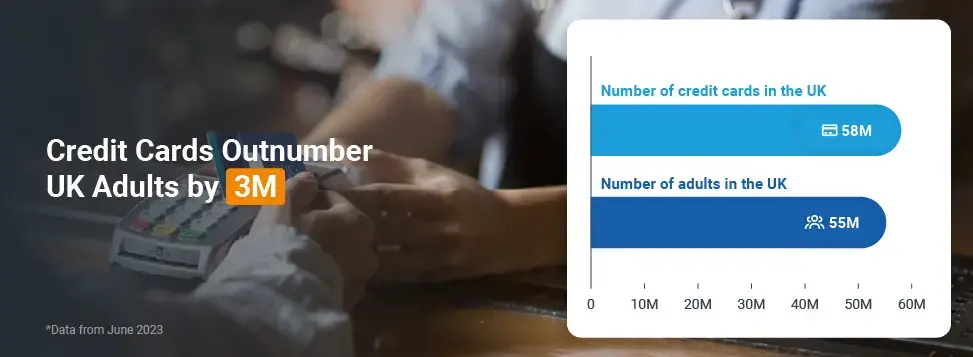
The number of credit cards exceeds the adult population, which suggests that many people hold more than one account. This can offer flexibility, but it can involve keeping track of multiple balances and repayment dates.
6. 360 million credit card transactions were made in January 2026
High transaction volumes show how frequently credit cards are used for day-to-day spending. This highlights their role as a payment method, not just a borrowing tool.
7. Credit card transactions increased by 3.6% year on year
A rise in transaction volume between January 2025 and January 2026 suggests continued growth in credit card usage. This may reflect changes in spending habits, including increased reliance on card payments for everyday purchases.
8. Total credit card spend reached £21.4 billion in January 2026
The scale of spending indicates how central credit cards are to consumer activity. This level of usage reflects both routine purchases and larger credit card transactions.
10. Credit card spend increased by 3.1% year on year in January 2026
Spending growth broadly in line with transaction increases suggests stable usage patterns. This may indicate that while more transactions are taking place, the average spend per transaction has remained relatively consistent.
Buy Now, Pay Later and alternative credit statistics
Alternative forms of credit have become more visible in recent years, particularly for everyday spending. Options such as Buy Now, Pay Later (BNPL), credit unions, and borrowing from friends or family can sit alongside more traditional lending products. These figures show how widely they are used and how borrowing patterns differ.
1. 10.9 million adults used deferred payment credit in 2024
Deferred payment credit, including BNPL, is now used by a significant number of people in the UK. Its growth is linked to how often it’s offered at online and in-store checkouts, making it widely available for smaller purchases.
2. Around 25% of UK adults have used Buy Now, Pay Later as of April 2025
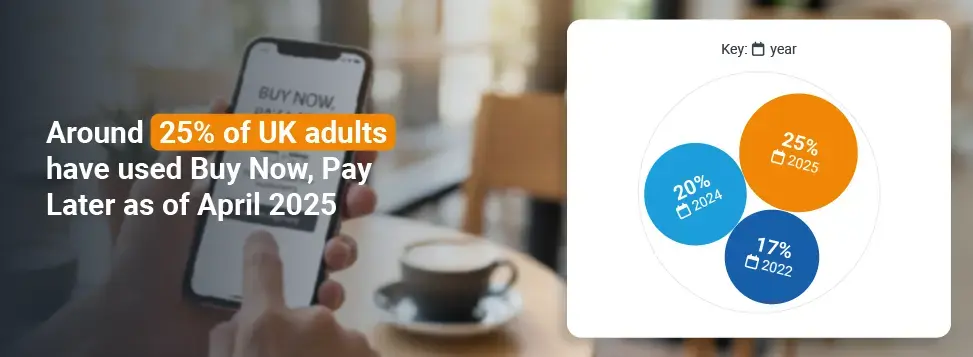
This suggests that Buy Now, Pay Later is now widely used alongside other forms of credit. Its integration into online and retail checkouts may make it a more visible option for spreading the cost of purchases. This is up from one in five (20%) in 2024 and 17% in 2022.
3. Buy Now, Pay Later usage is highest among 25–34 year olds at 41%
As of April 2025, usage is higher among younger adults, with 32% of 18 to 24-year-olds also reporting use, compared to 13% of those aged 55 to 75. This could be down to differences in spending habits, access to credit, or how these products are presented at checkout.
4. 55% of BNPL users used it to manage budgets or afford purchases upfront in 2024
More than half of users report using BNPL to manage cash flow or make purchases they could not pay for in full at the time. This indicates that, for many, it is often used to spread the cost of purchases rather than for long-term borrowing.
5. 1.9 million adults use BNPL frequently as of May 2024
Frequent use, defined as 10 or more times in a year, suggests that some individuals use BNPL regularly. This may reflect convenience, but it can also require careful tracking to ensure repayments remain manageable.
6. 34% of renters use Buy Now, Pay Later, compared to 15% of homeowners as of April 2025
Usage differs by housing situation, which may reflect differences in financial flexibility, access to credit, or budgeting needs across households.
7. The UK Buy Now, Pay Later market increased from £1.23 billion to £13.76 billion in five years (2019-2024)
This increase reflects how the availability and use of these products has changed over the period measured. Increased availability may contribute to their use for everyday spending. The deferred payment credit market has more than quadrupled since the COVID-19 period. This reflects significant growth in retail-linked credit options, including instalment and deferred payment products.
8. The FCA found BNPL users are almost twice as likely to be in serious financial distress in 2025
Some data suggests that people using Buy Now, Pay Later may be more likely to experience financial pressure. This does not apply to every individual, but it highlights the importance of reviewing repayments and keeping them manageable.
9. BNPL users have a higher average unsecured debt (£3,206 vs £1,674) in 2022
Higher average debt levels may reflect differences in financial circumstances or borrowing patterns, although individual situations will vary.
This may be a risk indicator, or it may suggest that BNPL users are more comfortable managing credit.
10. BNPL users have higher average credit card balances (£1,568 vs £868) in 2022
This suggests that Buy Now, Pay Later may be used alongside other forms of credit. Understanding total borrowing across products can help when assessing affordability.
11. As of May 2024, 1.1 million adults have £500 or more in outstanding BNPL debt
Higher outstanding balances suggest that people are using Buy Now, Pay Later more widely. However, a larger balance doesn't definitively prove more frequent use; it could just indicate that users are making a few high-value purchases rather than many smaller ones.
This can mean repayments are spread across different providers or schedules.
12. 5.3 million adults had a loan from friends or family
Borrowing from personal networks remains a common alternative to formal credit. These arrangements may offer flexibility, but they can also depend on personal relationships and informal agreements.
13. 26% of people borrowed from family, and 15% from friends between April 2024 and April 2025
Borrowing from personal networks remains a common alternative to formal credit. While it is often a good source of borrowing to avoid taking out a loan, it can negatively impact relationships if repayment difficulties occur.
14. 16% of loans from friends and 8% from family between April 2024 and April 2025 involved interest
While some informal borrowing is interest-free, this shows that costs can still apply in certain situations. Terms are often agreed privately rather than formally structured.
15. 35% of 18–24 year olds borrowed under £250 from family between April 2024 and April 2025
Smaller borrowing amounts are more common among younger adults. This may reflect short-term cash flow needs rather than larger borrowing requirements.
16. 21% of 18–24 year olds borrowed under £250 from friends between April 2024 and April 2025
This further highlights how smaller, informal borrowing can help manage short-term expenses, particularly among younger age groups.
17. In 2024, 700,000 adults held a credit union loan
In 2024, credit union loans accounted for 1.3% of all mainstream regulated credit agreements in the UK, up from 1.0% in 2020.
Credit unions provide an alternative source of borrowing, often with a community focus. Their usage reflects demand for more structured retail credit options.
18. 600,000 adults used employer salary advance schemes
Salary advance schemes allow employees to access earned income before payday. Their use may help some individuals manage short-term cash flow without taking out traditional loans.
19. Half a million adults held pawnbroking loans
Pawnbroking loans involve borrowing against personal items. Their continued use may reflect situations in which people prefer not to take on unsecured debt or where access to other forms of credit is more limited, depending on individual circumstances.
20. 300,000 adults borrowed from an unlicensed or informal lender
This is around 4% of adults in Great Britain. Although this represents a small proportion of the population, it’s likely to be understated due to under-reporting. This reflects that some individuals may not be accessing mainstream or regulated credit, which can be linked to a range of financial or personal circumstances.
21. Lending at the UK's largest pawnbroker increased by 14% to £146 million in 2024
Growth in pawnbroking lending points to increased activity in this part of the market. This may reflect demand for short-term, asset-backed borrowing, particularly where access to other forms of credit is more limited.
22. 9% of 18–34 year olds report using illegal lending between April 2024 and April 2025, compared to 2% of those aged 35–75
Higher usage among younger adults may reflect differences in access to credit, income stability, or financial resilience.
23. 10% of minority ethnic adults report using illegal lenders between April 2024 and April 2025
This includes 12% of Black adults, 8% of Asian adults, and 3% of White adults. These differences may reflect a range of financial and structural factors affecting access to credit.
24. People who were declined for credit were nearly four times more likely to use illegal lenders (15% vs 4%) between April 2024 and April 2025
This could mean that limited access to regulated borrowing options may increase the likelihood of turning to unregulated sources.
25. 37% of illegal lender users reported contact from debt collectors, bailiffs, or court action between April 2024 and April 2025
This is higher than comparable figures for payday loans (28%), personal loans (14%), and credit cards (6%), suggesting greater risks associated with unregulated borrowing.
Who uses short-term loans and credit?
Borrowing patterns are not evenly distributed across the population. Some groups are more likely to use short-term loans or credit options, often reflecting differences in income, housing, financial resilience, and access to other forms of borrowing. These figures help build a clearer picture of who is most affected.
1. 18-24-year-olds are more likely to hold high-cost credit, at 12%
Younger adults are more likely to use high-cost credit than the wider population. This may reflect earlier stages of financial independence, where savings are still being built, and access to lower-cost mainstream credit options may be more limited. Approval is not guaranteed, and affordability checks apply.
2. 12% of low-resilience adults held high-cost credit
Financial resilience plays a key role in borrowing behaviour. Those with lower resilience, such as limited savings or higher financial pressure, may be more likely to consider short-term credit when unexpected costs arise.
3. 59% of payday loan borrowers had household income below £30,000 (vs 38% of UK adults)
Lower-income households are more heavily represented among payday loan users. This reflects tighter budgets and fewer financial buffers, which can influence how different forms of credit are used in certain situations.
4. 37% of payday loan borrowers and 29% of short-term instalment borrowers are aged 25 to 34
This age group appears prominently among borrowers. This stage of life can involve a mix of financial responsibilities, such as housing and living costs, which may affect how credit is used.
5. 37% of high-cost credit borrowers are tenants
Housing status appears to be linked to borrowing patterns. Tenants may have different financial commitments than homeowners, which can influence how and when they use credit.
6. Around 62% of people seeking debt support were renters in June 2025
This includes both private renters (33%) and those in social housing (29%). Housing costs can play a significant role in overall financial pressure, depending on individual circumstances.
7. 67% of payday loan borrowers and 49% of short-term instalment borrowers are over-indebted
A higher proportion of borrowers are already managing significant levels of debt. This suggests that short-term credit is sometimes used alongside existing commitments, rather than in isolation.
8. 41% of short-term instalment loan borrowers report lower confidence managing money (vs 24% of UK adults)
Lower confidence in managing finances is more common among this group. This may influence how individuals approach borrowing and repayment decisions.
9. 31% of County Court Judgements are received by 26-35-year-olds
Younger adults are more affected by court judgments related to debt. This may reflect a combination of borrowing patterns and financial pressures faced by this age group, though individual circumstances vary.
Financial pressure and debt statistics in the UK
Short-term borrowing is often linked to wider financial circumstances. These figures highlight how many people are managing tight budgets, limited savings, or ongoing financial pressure. Understanding this context helps to show how different forms of credit are used at certain times.
1. 7.4 million adults struggled to pay bills or credit repayments in 2024
Many adults reported difficulty keeping up with bills or credit repayments in 2024. In these situations, some people may look at different ways to manage costs, depending on their circumstances.
Borrowing may not be suitable if you’re struggling with ongoing bills. For free, independent advice, visit moneyhelper.org.uk.
2. Cost-of-living increases were one of the most commonly reported reasons for debt (18%) in June 2025
Recent data shows that rising living costs are one of the most frequently cited reasons for debt, alongside lack of control over finances (18%) and unemployment or redundancy (15%).
This shows that debt is often linked to wider financial pressure rather than a single unexpected event.
3. 8% of people say they need credit to cover everyday living costs
Using credit to manage essential spending can indicate ongoing financial pressure, particularly where income does not fully cover regular outgoings.
4. The average household bill arrears balance is around £4,797 as of June 2025
Average arrears across household bills, including rent, utilities, and council tax, remain relatively high. This may reflect ongoing pressure on household budgets.
5. People in debt hold an average of 8 debts and 4 arrears
This suggests that financial pressure often involves multiple commitments rather than a single debt, which can make repayment more complex to manage.
6. Around 29% of people in debt have a negative monthly budget
A negative budget means that outgoings exceed income. This can make repayments harder to manage without making adjustments or seeking support.
7. 2.7 million people sought financial advice due to financial pressure
Seeking advice can indicate that individuals are actively looking for ways to manage their finances. This may include reviewing budgets, understanding borrowing options, or finding support when repayments become harder to manage.
8. 20% of people reported having no savings between April 2024 and April 2025
Estimates vary, but some data illustrates that a larger proportion of people may have no financial buffer. This can make it harder to absorb unexpected costs.
9. 20% of people say they run out of money before payday
Running out of money before payday may indicate short-term cash flow pressure, particularly where income and outgoings do not align.
10. 21% have less than £1,000 in emergency savings
Limited savings can make it more difficult to manage short-term financial shocks. Even relatively modest unexpected costs may require adjustments to spending or the use of credit.
11. One in four UK adults is in financial difficulty or could quickly become so after a shock
A large number of people may be financially vulnerable. This includes both those already experiencing difficulty and those who could face challenges if their circumstances change.
12. 4.2 million missed bills or loan payments in at least three of the previous six months
Repeated missed payments can indicate sustained financial pressure. This can also affect credit records, potentially influencing access to future borrowing options.
FCA rules require lenders to provide appropriate support when customers experience payment difficulties. Anyone concerned about making a repayment should contact their lender as early as possible to discuss the options available.
13. 44% stopped or reduced saving or investing to make ends meet
Many households have adjusted their financial behaviour in response to rising costs. Reducing savings or investments can provide short-term flexibility, although it may affect longer-term financial resilience.
14. A quarter of households could not afford a £500 emergency bill without borrowing
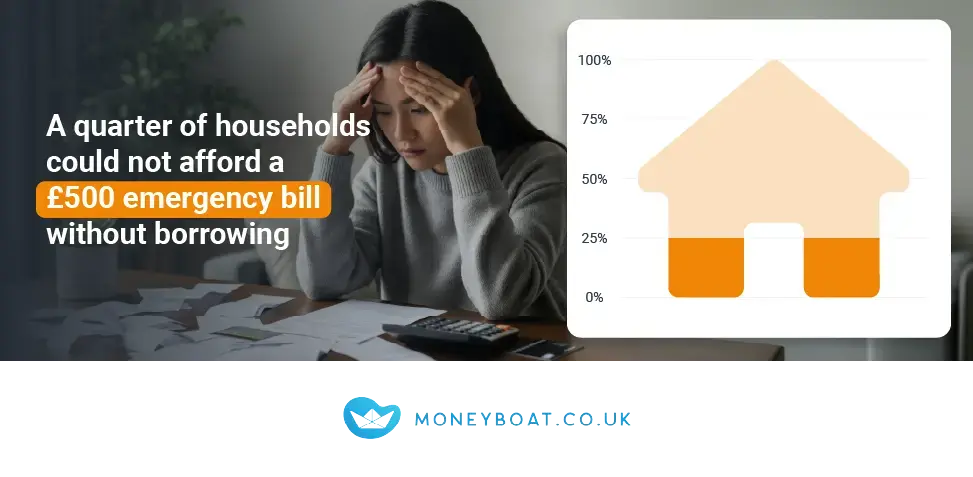
This suggests many households may have limited financial flexibility when unexpected costs arise. A relatively small expense may still require adjustments to spending, support from family or friends, or other financial options, depending on individual circumstances.
15. Almost 60% of payday loan borrowers remain financially vulnerable for 12+ consecutive weeks
Sustained vulnerability over several weeks demonstrates that financial challenges can persist beyond a single short-term issue. This may influence how and when credit is used during that period.
16. Two-thirds of payday loan borrowers experience consistent financial difficulties
A majority of borrowers report ongoing financial challenges. This shows that short-term credit is often used alongside broader financial pressures rather than as a standalone solution.
Andy Forsyth, Chief Financial Officer at Evergreen Finance London Ltd, parent company and FCA-authorised lender behind Moneyboat comments:
"Missed repayments affect more than just the outstanding balance. They can make future borrowing more difficult, increase financial pressure and, depending on the lender and circumstances, affect a customer's credit record. Anyone who thinks they may struggle to repay should contact their lender as early as possible to discuss the support available.
“Keeping track of regular outgoings and reviewing subscriptions or non-essential spending can make a difference. If things start to feel difficult to manage, reaching out early to creditors or using free, independent support such as moneyhelper.org.uk can help people understand their options.”
Wider lending market trends in 2026
The UK lending market includes a wide range of products beyond short-term loans and mainstream consumer credit. These figures provide context on how different forms of borrowing are used across the population and how short-term lending fits within the wider credit market.
1. 6.4 million adults use retail instalment credit
Retail instalment credit is commonly used for spreading the cost of purchases, often at the point of sale. Its usage highlights the demand for structured repayment options linked directly to consumer spending.
2. 6.3 million adults hold a store card
Store cards remain widely used, particularly in retail settings. They can offer flexibility for purchases within specific brands, although terms and costs vary depending on how they are used.
3. 6.1 million adults use catalogue credit or shopping accounts
Catalogue and shopping credit accounts provide another way to spread payments over time. Their continued use reflects that many consumers choose to spread the cost of purchases using different forms of retail credit, although costs and repayment terms can vary.
4. 2.0 million adults use retail hire purchase
Hire purchase agreements are often used for higher-value items, where ownership transfers after all payments are made. This structure involves fixed repayments over an agreed period, after which ownership transfers to the customer.
5. Over 65% of deferred payment credit transactions were linked to clothing, fashion, and footwear in March 2023
This indicates these products are commonly used for everyday retail purchases, particularly at the point of sale.
6. 1.0 million adults use rent-to-own finance
Rent-to-own allows access to household goods through regular payments, often including service or maintenance. It may be used where paying the full cost upfront isn't possible, although customers should carefully consider the total cost before entering into an agreement.
What these short-term loan statistics show
Across the data, short-term borrowing has a clear role within the wider UK credit market. It sits alongside other forms of borrowing such as credit cards, personal loans and car finance, each used in different ways depending on individual circumstances.
Recent data on high-cost credit use sits alongside statistics on savings levels and financial difficulty. This suggests that, for some households, borrowing decisions may be influenced by limited financial buffers or short-term changes in income and outgoings.
Usage varies across different groups. Younger adults and those with lower financial resilience are more likely to use high-cost credit, reflecting differences in income stability, savings levels and access to other borrowing options.
At the same time, alternative credit products now form part of the wider UK lending landscape. Products such as Buy Now, Pay Later are now part of everyday spending for many people, illustrating how the range of consumer credit products has changed over time.
Some borrowers may use short-term loans to help cover temporary financial gaps, although regulated lenders carry out affordability assessments and eligibility criteria apply before a loan can be approved. They are not designed for ongoing financial difficulties. If money worries are ongoing, it’s worth looking at other options, such as speaking to your existing creditors or getting free, independent guidance from organisations such as moneyhelper.org.uk.
Andy Forsyth, Chief Financial Officer at Evergreen Finance London Ltd, parent company and FCA-authorised lender behind Moneyboat:
"These statistics highlight how short-term credit fits within the wider UK financial landscape, but they also reinforce an important point: borrowing should always be considered carefully.
“Before taking out any form of credit, it's worth exploring whether savings, adjusting household spending, family support or free debt advice could help resolve the situation. Where borrowing is appropriate, customers should only choose credit they understand, can comfortably afford to repay, and that genuinely meets their needs.”
Alternatives to short-term borrowing
Short-term loans are only one option available when unexpected costs arise. Depending on your circumstances, there may be alternatives that better suit your needs.
These include:
- Using emergency savings, if available.
- Speaking with your existing creditors about payment plans or temporary support.
- Checking whether you're entitled to benefits or other financial assistance.
- Borrowing through a credit union, which may offer lower-cost borrowing for eligible members.
- Asking family or friends for support, where appropriate and practical.
- Accessing free, independent guidance from organisations such as moneyhelper.org.uk or stepchange.org, particularly if money worries are becoming ongoing.
If you're finding it difficult to manage regular household bills or existing debts, taking on additional borrowing may not be the right solution. Seeking advice early can help you understand the options available before financial pressures become more difficult to manage.
Sources and methodology
Moneyboat is a UK-based direct lender authorised and regulated by the Financial Conduct Authority (FCA).
This page has been created to bring together publicly available data on short-term borrowing and wider lending trends, to present clear, balanced information so people can better understand their options. It is intended for general information only and does not constitute financial advice or a recommendation to borrow. For free, independent guidance, visit moneyhelper.org.uk.
The statistics on this page are drawn from a range of publicly available sources, including Cornell University, the Competition Commission, the Financial Conduct Authority (FCA), the Financial Conduct Authority (FCA), Debt Advisory Services, Fair4all finance, Fair4allFinance, the Finance & Leasing Association (FLA), Money Age, Lexis Nexis, The Money Charity, The One Stop Money Shop, Bank of England, Consumer Credit Compliance, Money, Oxlade & Bond Limited, Research Gate, StepChange, StepChange, The Guardian, and UK Finance. These sources provide insight into different parts of the UK credit market, from short-term lending to wider consumer borrowing trends.
Blog Disclaimer
We do all we can to bring you interesting, practical and valuable information. However, please understand the following:
- Moneyboat.co.uk are in no way connected or affiliated with the application or affiliate links mentioned in this or any article. We do not receive any commission and are not responsible for any charges that may result from any free trials or paid subscriptions.
- Moneyboat.co.uk does not provide medical advice It is intended for informational purposes only. It is not a substitute for professional medical advice, diagnosis or treatment. Never ignore professional medical advice in seeking treatment because of something you have read on the site. If you think you may have a medical emergency, seek medical advice immediately or dial 999.
- Information and data on this blog are for information purposes only. While we work hard to ensure it is accurate, we cannot accept responsibility for the accuracy, completeness, suitability or validity of any information provided on the blog. We will not be liable for any errors, omissions, losses, injuries or damages arising from its display or use. All information is provided with no warranties and confers no rights.
If you feel that any of the information published on our blog is not accurate, please notify us via email at thecrew@moneyboat.co.uk.
Representative Example: Borrow £400 for 4 months: 3 monthly repayments of £156.09 followed by a final repayment of £156.07. Total repayment £624.34. Interest rate p.a. (fixed) 288.35%. Representative 1,267.9% APR.
Compare Moneyboat loans.
Warning: Late repayments can cause you serious money problems. For help, go to www.moneyhelper.org.uk.
Latest blog posts

Celebrating the Easter holidays on a budget
Make sure your Easter celebrations are amazing without breaking the bank. In this guide, see smart shopping hacks, suggestions for dining out for less, and ideas for fun, cheap, local activities over the holidays.

Short-term loans and their advantages
Explore the advantages and disadvantages of personal short-term loans, including payday loans, so you make the right decision when you need funds fast.

How to build an emergency fund
Ready to get started on building an emergency fund? Learn what an emergency fund is, how much to save, and how it can help you avoid short-term borrowing

How to borrow money from family and friends
Learn about family and friend loan agreements and the pros and cons of borrowing money from your loved ones – check to see if it's a good option for you!

What is the difference between APR and interest rate?
Learn the difference between APR and interest rate, how each affects borrowing costs, and why both matter when comparing loans.

Can you pay off a payday loan early?
Wondering if you can pay off a payday loan early? Learn how early repayment works, the pros and considerations, and what to check before you repay.

Why can’t I get a loan?
Wondering why you’ve been refused for a loan? We explore the most common reasons lenders say no, as well as how to increase your chances of approval.

What is a pre-approved loan?
Curious about pre-approved loans and how they work? Find out what loan pre-approval means, whether it guarantees acceptance, and if it’s right for you.